Branding identity for contemporary art galleries
Example the Museum of Modern Art (MoMA)
Present-day art has been flourishing in a much-liberated environment. Nowadays, art has not been made limited by laws or conventions. It exhibits independently the intellectual and meditative ideas that are not necessarily in compliance with the standard or acceptable beliefs (Soha, 2013). Museum branding has gained much popularity in the art and culture sector. The museums and art collections laid the foundations of the brand identity. This involves celebrity endorsement that works as influencers to create a brand identity. Apart from marketing, strong networking is built, aiming to manage the brand identity. Amid the increasing trend, creative marketing has also played a greater role in establishing organizational relations and networking as there is much space and capacity for the museums to manage their brand identity better while engaging with key stakeholders (Pusa, 2009). In other words, it can be inferred that marketing and branding have become two fundamental elements that are prerequisites for museums to maintain their standing in the ever-evolving institutions of culture.
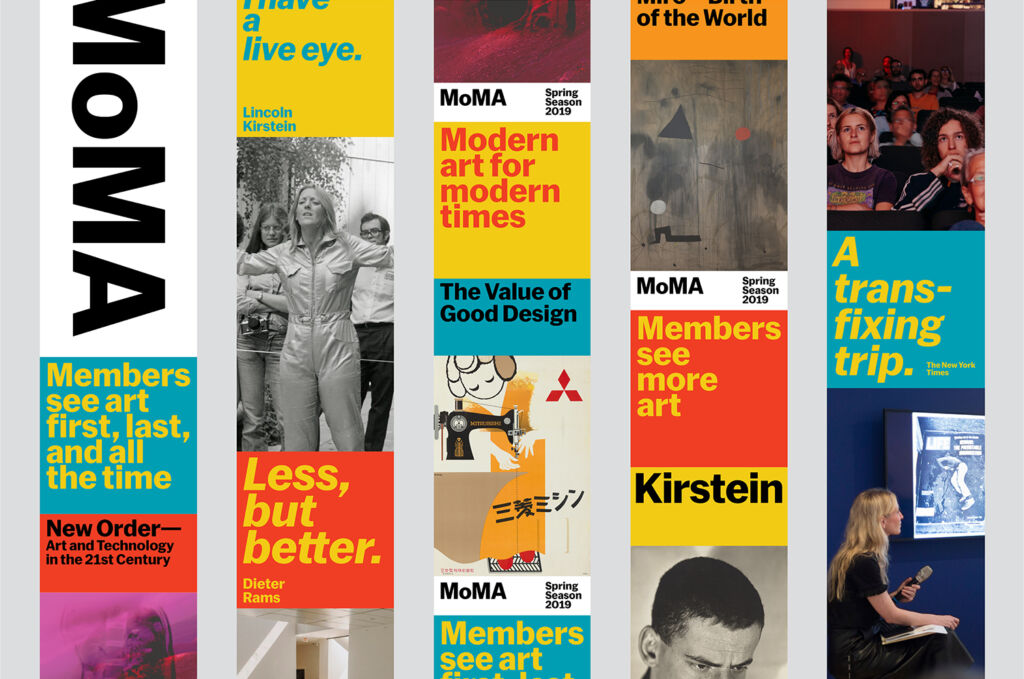
Baird R., (2019) BpO: MoMa by Order
Moreover, brand identity involves symbolizing a museum as a product objectified as necessary for a unique museum experience. In this instance, varied aspects of a product are considered necessary, such as services, scope, and quality that create the brand identity. It is worth mentioning that the quality of the exhibition has much importance with reference to the reputation of an artist. The artist’s reputation assists in popularizing the museum because an artist demonstrates the quality, themes, and artistic values (Christy, 2019). Additionally, other features of artworks such as architecture, premises, genres and signs are the secondary elements required for brand identity. The evolution of the Museum of Modern Art (MoMA) can be referred to as the origin of brand identity in art. The day of November 21, 1950, marked the exhibition of MoMA in New York. It aimed to exhibit the modern designs related to appliances and furnishings made by Ray Eames and Charles. This exhibition was featured with the amalgamation of moving objects along with objectifying the aesthetic elements of home appliances (Rogers and Woznick, 2014).
It is a strong new direction, but the continuity is clear in the presence of an evident modularity system. Of course, visual identity systems are inherently programmatic, however, some are less prominent in their modularity than others. New contexts and digital-first thinking has pushed the MoMA visual identity from the grids and guides of editorial and print publishing into a dynamic feed of colour, image, type and motion.
This venture organized three shows every year in Chicago and New York. The designs exhibited in the MoMA were different to the works of modern-day artists Matisse, Picasso and Surrealism (Martin and Martin, 2009). Moreover, the MoMA has brought about a revolution in artworks in the form of panoramic art, European sculpture and paintings. It has been continuing the redefined and refined art in the western world. The MoMA started from only one collection in 1952. However, it has expanded its works by making the greatest art collections of avant-garde painting, multi-media, film, and sculpture in the world of creativity and culture industry (Stradling, 2010). The MoMA is adamant about presenting perfect speculation of artistic values and features of the past and contemporary arts. It adds up to the significance of modern-day art as it contemplates a holistic and integrated view of contemporary art. Hence, it has become the leading characteristic of the contemporary arts due to presenting an integrated picture of modernism (Rasmussen, 2021).
References
-
- Christy, T., 2019. Perancangan Brand Identity Wisata Edukasi Seni Budaya Eco Bambu Cipaku (Doctoral dissertation, Universitas Multimedia Nusantara). Available here: https://kc.umn.ac.id/10394/[Accessed on 27 July 2021]
- Martin, R. and Martin, R.L., 2009. The design of business: Why design thinking is the next competitive advantage. Harvard Business Press. [Online] Available here: https://hbsp.harvard.edu/product/12176-PDF-ENG[Accessed on 27 July 2021]
- Pusa, S. and Uusitalo, L., 2014. Creating brand identity in art museums: A case study. International Journal of Arts Management, 17(1), p.18. [Online] Available here: https://www.researchgate.net/publication/272008733 [Accessed on 27 July 2021]
- Pusa, S., 2009. Creating brand identity in art museums-A case study on three art museums. [Online] Available here: http://urn.fi/URN:NBN:fi:aalto-201111181189 [Accessed on 27 July 2021]
- Rasmussen, B., 2021. DESIGN is everywhere: Elements of Design and MoMA’s Evolving Design Pedagogy. Journal of Design History. [Online] Available here: https://doi-org.eres.qnl.qa/10.1093/jdh/epaa027 [Accessed on 27 July 2021]
- Rogers, R.C. and Woznick, A.M., 2014. Report for “Fostering an ‘open’ culture at Empire State College: An ethnographic study of Niagara Frontier Center participant observations” (AY 2013-2014). The Buffalo Project.
- Soha, D.S., 2013. Contemporary art museum (Agargaon, Sher E Bangla Nagar, Dhaka) (Doctoral dissertation, BRAC University). [Online] Available here: http://hdl.handle.net/10361/2994 [Accessed on 27 July 2021]
- Stradling, D., 2010. The Nature of New York: An Environmental History of the Empire State. Cornell University Press. [Online] Available here: https://books.google.co.uk/books?hl=en&lr=&id=sJur-ecCVDgC&oi=fnd&pg=PR9&ots=WirnCEkIag&sig=h7Y7nMC4jC67ugHYsnNI-dc2P-Y&redir_esc=y#v=onepage&q&f=false [Accessed on 27 July 2021]
- Baird R.. (2019) BpO: MoMa by Order [Online] Available here: https://bpando.org/2020/01/02/moma-by-order/ [Accessed on 27 July 2021]
