Golden Ratio in architecture and design example
The Golden Ratio is considered to embody a perfect proportion between two quantities. Although the rationale of the phenomenon is rooted in mathematics, but it seems to appear in many other disciplines, such as the visual arts, architecture, design, philosophy or even science.
In the 20th century, many modern architects tended to violate the ideal proportions of classical architecture. The results are often unpopular. It seems that many architects today have returned to the “golden ratio”, which is an essential tool in shaping the appearance of structures, from large institutions and commercial buildings to villas (Akhtaruzzaman and Shafie 2011).
The golden ratio is defined by different names. A few of the names are “Phi, the Golden Mean, the Divine Section, the Golden Proportion, and the Divine Proportion” (Yousef ABDEL-BARI, 2020). Almost all-natural elements contain this amazing ratio. The golden ratio of nature exists from the shape of the universe to the human body and from the shape of clouds to the shape of flowers and leaves.
The golden ratio of nature exists over and over again. It also has the ability to make the elements balanced and attractive. That is why people have always used the same proportions in art, mathematics, architecture and music since ancient times. Let’s try to find and understand how this golden ratio better emerges.
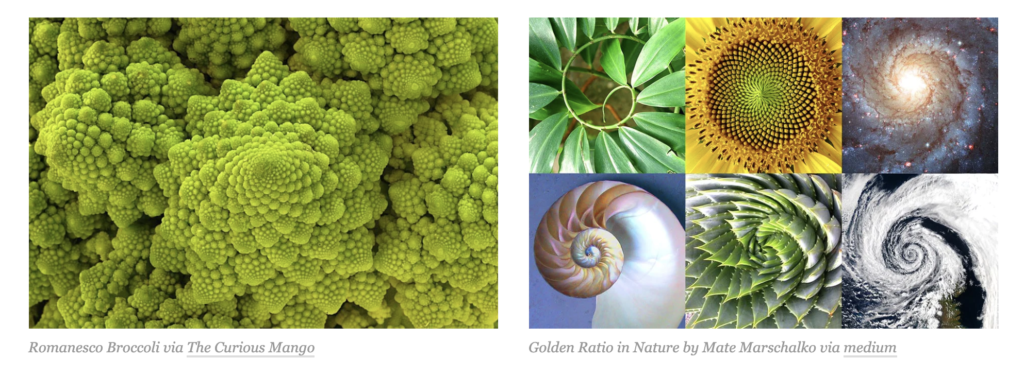
The Golden Ratio and how to use it in graphic design (image source: www.99designs.co.uk)
Nowadays, for designing buildings the golden ratio is also used and it is easy to embed it on every page programmers want to create. For example, the “rule of thirds” is the fastest way to create the best layout for a page, as its three horizontal lines and three vertical lines divide the rectangle and automatically focus (Bejan 2009). Architects can use any shape, but using a rectangle brings it closer to the golden rectangle and gives the best effect. Architects can set these dots to work with the pixels on the page, but keeping them at 1,680 gives the best results. Therefore, architects can easily design their projects successfully.
I remember from my architectural studies all the great architects from Antiquity that used this formula in every step of drawing projects. The iconic architects flourished in the Roman Empire and Ancient Greece. I believe that we should know our history and how we arrived at this point today, to be able to look in the future with the lesson learnt from the past, to know what was good and tested during the time and what we should improve for the future.
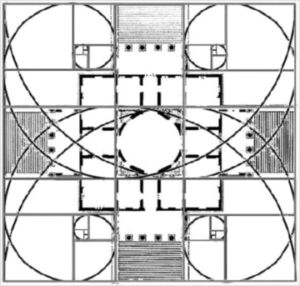
A golden section diagram of Villa La Rotonda – arch. Palladio – (image source: https://doi.org/10.1016/j.aej.2015.03.012 – fig.14)
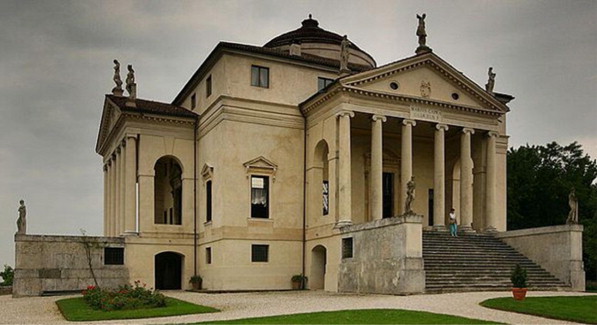
A golden section diagram of Villa La Rotonda in Vicenza – arch. Palladio – (image source: https://doi.org/10.1016/j.aej.2015.03.012 – fig.12)
Now, using the golden ratio tool when designing a building, it is now very easy to calculate the mean and median (Nabavi and Ahmad 2016). As an application, the concept of “simple tasks” is used to a new level. Now architects can easily buy this program and have it guide them through all the design steps. Its features include reusable “favorites” for repetitive tasks and a “click button” that allows architects to use it in 3D. There are also some great tools to make the architect jobs easier and faster and achieve perfect accuracy. Take an example of a “Typography calculator”. By providing basic information at the beginning, such as the required font size or the width of the building, it’s easy to adjust it so that it always adjusts the font for best results (Thapa, G.B. and Thapa, R., 2018). Another tool to help achieve a golden ratio in all aspects of architecture is “PHICALCULATOR”. Its simple and accurate functionality allows architects to calculate any number of PHI values in minutes! This will not only save architects time but speed up the process and make architects proud to do a good job (Ghorbani, 2019).
From the transformation of nature into spiral galaxies, from artificial architecture to art and web design, the golden ratio is evident in all modes of the universe. It all follows the rules of design and perfect symmetry, which makes everything organized, harmonized and resonant. Its incredible properties continue to dazzle those who enter the realm of this potential, and for those who dare to reveal more secrets, they discover a new world every step of the way. It is a mathematical miracle, a perfect divine part.
References
- Akhtaruzzaman, M. and Shafie, A.A., 2011. Geometrical substantiation of Phi, the golden ratio and the baroque of nature, architecture, design and engineering. International Journal of Arts, 1(1), pp.1-22.
- Bailey J., (2019) The Golden Ratio and how to use it in graphic design [Online] Available here: https://99designs.co.uk/blog/tips/the-golden-ratio/ [Accessed on 05 June 2021]
- Bejan, A., 2009. The golden ratio predicted: Vision, cognition and locomotion as a single design in nature. International Journal of Design & Nature and Ecodynamics, 4(2), pp.97-104.
- Ghorbani, H., 2019. Golden Ratio: The Mathematics of Beauty. Mathematics Interdisciplinary Research.
- Nabavi, F. and Ahmad, Y., 2016. Is there any geometrical golden ratio in traditional Iranian courtyard houses?. ArchNet-IJAR: International Journal of Architectural Research, 10(1), p.143.
- Thapa, G.B. and Thapa, R., 2018. The Relation of Golden Ratio, Mathematics and Aesthetics. Journal of the Institute of Engineering, 14(1), pp.188-199.
-
Shekhawat, K. (2015) ‘Why Golden Rectangle Is Used so Often by Architects: A Mathematical Approach’. Alexandria Engineering Journal 54, no. 2 (1 June 2015): 213–22.
[Online] Available here: https://doi.org/10.1016/j.aej.2015.03.012 [Accessed on 5 JUNE 2021]
- Yousef ABDEL-BARI, S., 2020. THE GOLDEN RATIO AND ITS APPLICATIONS IN THE DEVELOPMENT OF FUNDAMENTALS OF INTERIOR DESIGN CURRICULUM. International Journal of Education and Learning Research, 3(1), pp.1-7.
