Virtual art exhibitions – artists
According to Deloitte Consulting LLP & Consumer Technology Association (2018), the term digital reality technology refers to a cluster of technologies that can immerse partially or fully users in a computer-generated virtual environment. In general, these technologies include the following immersive technological platforms, ranging from augmented (AR), mixed (MR), virtual reality (VR), 360-degree video, etc. (Kang and Yang, 2020).
Since the announcement of social restrictions’ status due to the outbreak of corona, suddenly, all social interactions and physical activities must change. It starting from social restrictions to self-quarantine. Until finally on, social media appear hashtags #stayathome. Almost all activities outside the home have stopped, from schools, offices, art exhibitions, performances, and many others. Activities are transferred through the house and rely on digital communication technology or commonly known as the internet. Eventually, art activities were also affected, one of which was the art exhibition. The art exhibitions activity, commonly called an exhibition among art activists is artwork presentation. The definition of being presented is a finished work placed in an exhibition room ready to be shown or exhibited to the public (Tunnikmah, 2021).
The activity of exhibiting artworks is part of a series of activities, an estuary of the artistic process. Making artwork itself is an activity that can still be done when social restrictions are imposed because it is an individual activity. Usually, artworks are made in a studio which part of the artist residence. The appeals stay at home make social interactions, mostly move to social media. The higher intensity on social media coupled with increasingly intense activities at home makes people feel free to share their daily activities at home, one of which is art. Starting from local and international musicians’ appearance, dance performances than other art forms also enlivened, such as fine arts. Several online art exhibitions are held on social media and websites. Like an exhibition in an offline showroom, online presentation of artworks experiences appreciation. Artworks display in internet-based media, usually called virtual space, experiences virtual appreciation (Algarni, M.S., 2021).
The internet has become part of many people’s daily activities, especially since smartphones’ emergence. The use of smartphones with the convergence of networks through digital communication technology has made the internet common in daily activities. Social media used through smartphones makes the internet a part of most human activities. Artists also use the internet as a medium for sharing information. It observes from the emerging of several sites that display works of art, such as Saatchyart.com, Artnet, ocula.com, art.com, artfinder.com, and indoor now. Sites that have sprung up are like online displays, only displaying works and cursory information about the artists creating the artworks.
Several exhibitions are carried out through Instagram, such as the Covid-19 Charity Exhibition organized by Nalarroepa Ruang Seni, Ruang Dalam Art House, and Lesbumi Jogja. Eighty-three artists participated in the exhibition, held from 15 May-15 June. Like physical exhibitions, there is a speech from the guest of honour. In this exhibition opening, there are Hilmar Farid (D.G. Culture), Oie Hong Djien (collector), and Jim Supangkat (curator). The exhibition opens at 15.30 through the live Instagram facility. Like a physical exhibition, under a photo of the artwork, there is text. It is called a caption containing the artist’s name, title, year, creation, size, and the media. The caption used in each artwork is displayed in one post containing two photos. The first photo shows the artwork displayed in a virtual room. The second photo is the full photo of the artwork.
Artworks are sorted alphabetically by artist name. The artworks arrangement is different from an exhibition room that considers visitors’ flow and the artwork’s visual form. The artworks are sorted alphabetically by name, as is usually done in exhibition catalogues. For the exhibition catalogue, a link is provided in the account bio. Another interesting virtual exhibition is the Virtual Graphic Poster Exhibition “At Home Does Not Mean Weakening,” initiated by Graphic Huru Hara, Serum Art Handling, and Gudskul. It is an art exhibition that physically held and then made a virtual form of an exhibition room containing artwork. The virtual exhibition can be accessed through http://gallery.gudskul.art/.
I chose to mention them because it was a movement that was held as an experiment – with exhibitions in containers and scanned into a virtual tour after everything was set in the space.
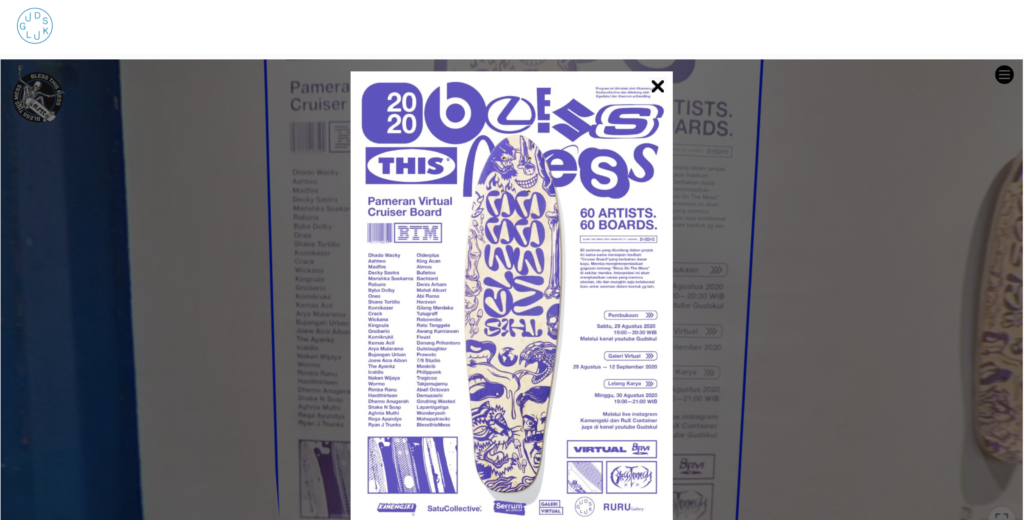
Bless this mess – Virtual exhibition (Image source: http://gallery.gudskul.art/bless-this-mess/)
The opening exhibition held on June 24, 2020, via Youtube Live, and the exhibition can be seen until July 25, 2020. The exhibition space physically exists and is prepared like art exhibitions are usually made. Virtual spaces were created using Matterpot, a 3D camera designed to scan home interiors. This software combines all the still images into one and creates a virtual tour of the house. It is not a virtual tour like in a slide show, but a tour where visitors can walk around on their own even though in the end to enjoy it with comfortable, collided with the quality of internet access. here are also fine arts, discussions, and tutorials. The online video contains not only the artwork but also the artist’s activity with 10-15 minutes. It is not ideal when it comes to quota usage for viewing videos as long as that. It is also not ideal to discuss whether it can replace physical art exhibitions, seeing the duration and capacity of videos, which not only contain artworks. When an exhibition, as a form of communication, changes the format, the form of communication that occurs also changes. The idea of changes that occur or impacts described by Lovejoy (2004), Digital Currents: Art in the Electronic Age.
Goya’s Graphic Imagination Virtual Opening | Met Exhibition (Video source: https://www.youtube.com/watch?v=GZW6OjARMGU)
The Met presented exclusively virtual exhibitions on their social channels during the pandemic and promoted artists even during the restrictions.
The internet’s challenge arises to explore the fundamental aspects of representation that have new meanings and new signs such as content and context. Until now, it realizes how the context could change. Context can change an artwork’s meaning on the internet, creating very different conditions for exchanging the two points. The intimate way of dealing with the site’s dynamic form carries information elements of information via different routes from different sources. There are many good possibilities, negative-positive involved when the artist’s artworks are shown on the internet, outside the traditional art context. Their artwork has the possibility of being nothing more than a coordinated series of global databases located anywhere but as a crossroads between commercialization(Tunnikmah, 2021).
References
- Kang Y. and Yang K.C. (2020) Employing digital reality technologies in art exhibitions and museums: A global survey of best practices and implications. In Virtual and augmented reality in education, art, and museums (pp. 139-161). IGI Global.
- Tunnikmah N. (2021) Impact of Covid 19 on the World of Fine Arts; Between Online Exhibitions, Virtual Exhibitions in Cyberspace Appreciation. Between Online Exhibitions, Virtual Exhibitions in Cyberspace Appreciation [Online] March 2021, Available at: https://papers.ssrn.com/sol3/papers.cfm?abstract_id=3800618
- Algarni M.S. (2021) Virtual Art Exhibitions In Times Of The Corona Pandemic. Al-Academy Journal (99), pp.441-480.
- The Met (2021) Goya’s Graphic Imagination Virtual Opening | Met Exhibitions
. [Online Video]. 19th February. Available from: https://www.youtube.com/watch?v=GZW6OjARMGU. [Accessed: 14 June 2021].
