My major project comes from a problem I noticed in the last year during my graduate and research program. In the last year, the world has faced major changes, and also, the arts and artists have faced something new to solve.
During my research, I noticed that a massive number of art galleries had to close. The lockdown period affected even large art museums that failed to support the rent during the restrictions. Those who succeeded were those who went online. Art consumers have not changed their preferences; only they have not been able to reach the art they visited/admired in museums in the past. That is why the auction houses have developed a growing inclination towards digital arts and not only but towards the digital way in which the works are exhibited. A major interest and the novelty that helped the art galleries with a sale to survive was the scanning of exhibitions in virtual tours. This process has exploded in the last year among most places of interest. Through this approach, visitors/art consumers were able to access and buy as usual from the comfort of their own home, through the usual devices they had in the house – phone, laptop.
The project I propose – a Virtual Art Gallery meets this and is an alternative that comes to the aid of beautiful consumers. Viart – Virtual art gallery is a gallery that exists in the virtual space but can be built in the future. Personally, I have years of study in high school and university on the side of architecture, and I have better understood the spaces and routes that people could naturally follow in a room. That is why it would be ideal if the gallery will be virtually successful and can be built. Virtual clients will be able to meet later in the real environment, and this would be the process towards which our society tends today. Testing a product on a large scale, and if its value increases and has a massive impact, it can be translated into reality.
The gallery currently proposed for this project contains three larger exhibitions. Most of the exhibited works are worked during the study year at MA DIGITAL MEDIA ARTS in different projects, but we also developed some new works, especially for this exhibit. A total of 21 works are exhibited – glitch art Urban and human touch, four zoomorphic art, and 10 in the intrapped collection – 35 works.
The proposed architectural volume hosts an exhibition – zoomorphic – with the possibility of having exhibited in the outdoor space sculptures and posters on the covered terrace near the entrance. This space creates a route that introduces the visitor to discover the artefacts with each step.
On the floor of the building is the main exhibition, which consists of three rooms that communicate with each other.
The main exhibition exhibits the glitch art technique with an urban theme. I chose this technique mainly in the presentation of artefacts because I discovered it in the first semester of study, and it took over me. I really liked how similar – the aesthetics of the ugly – this technique can create a work of art by altering the image. I was attracted by the freedom and the multitude of experimentation techniques they offer, but also the possibility to explore more and more on an artefact, even after long periods. In the room that presents the intrapped project – breathing art, I chose to keep a rigour in the room and chromatic. The room has beams to transpose the idea of the cage, to close in space, as well as the feeling felt during the pandemic and lockdown worldwide. That is why I chose to have a single statue that symbolizes a lonely individual in a room. The social distance and isolation that affected each individual, of greater intensity or not.
The novelty of the project, or what this gallery proposes, is accessibility. The possibility to be accessed through different communication media, media channels – easy to access and to attract as many visitors in an interactive trip to discover art much easier. Thus, the project is addressed to several types of people: those who are middle-aged and experienced in using the Internet and websites can access this project through the website viart.co.uk. For them, there is this virtual tour through which they can rotate 360 inside the main exhibitions and can view the exhibited artefacts. The proposed website is responsive – it can be easily accessed both from your laptop and from your phone or tablet.
Another group of people would be young people who are consumers of technology, immersive games, everything that is new in the field of technology, for there is the possibility to watch in VR the main exhibitions. This is easy to experience if there is a set of VR glasses – I used the Oculus Quest 2 headset and even a homemade cardboard box where you attach the mobile phone because the virtual tour presented can turn into a VR tour on the phone with the touch of a button.
Another category of people to whom the project is addressed can be professionals in the field who can access the exhibition in AR and can view the volume and exhibitions at different scales, as well as for the architects who will develop the project in the future if they want it.
Human interaction and socialization are natural things, but when some unexpected things like the pandemic force us to evolve in one approach or another, it is good to be prepared and to facilitate the artists to continue their perpetuation of beauty in everyday life, to perceive and understand more the creative approach, novice or professional, it is important not to let art go out for certain social reasons or restrictions.
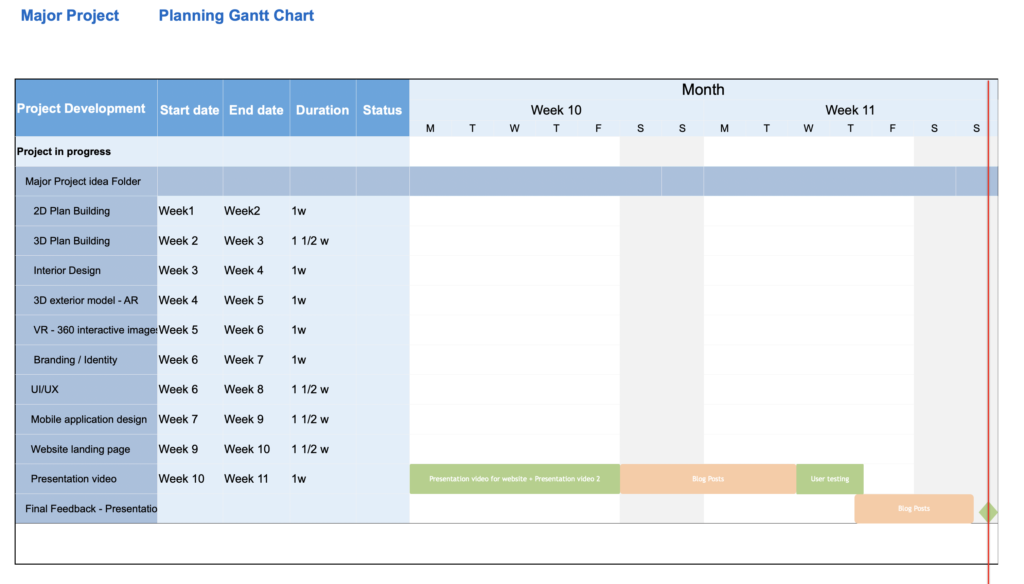
The creative process was an elaborate one because I had some well-defined stages at the beginning of the project. However, along the way, I realized that I would need more congruent parts, and I will have to develop everything not by segregation but simultaneously. I worked on several fronts, both on the website side and on the identity side, architectural concept, 3D or galleries. Every time something new or necessary appeared in the process of developing the project, I had to pay attention to it and fix the error. In the first part, the way we created the parts we were working on following the natural process of things. There were technical errors, and I saw that it takes a long time to work in some programs during the contouring of the volume concept and therefore, I resorted to an ios application that was much easier to access and experiment on volumes of 3D exposure variants. Through this process, I saved time. Later I translated it into 3D and exported the final exhibition variants. For export, I turned to a friend’s computer, as the system version I’m working on does not allow certain programs such as Autodesk 3dS Max and Vray / Corona.
On the presentation side, it was a challenge to upload 360 images exported from 3D in an interactive version. This required additional research and the use of templates in photoshop; even if the images were in the normal format, the export option must be reset in terms of images.
During the development of this project, I applied a lot of information that I accumulated and discovered in the last year. Working methodologies, looking for a viable alternative when time is limited for the launch of the project, the idea of having more development possibilities, I consider it a very important lesson to learn and help me in the future as a media artist to overcome a creative deadlock much easier. In the future, I hope to apply much more the notions learned during my studies and to develop projects of public interest that can be accessed through as many media communications.